The Basics of Landscape Astrophotography AKA How Do I Do Astrophotography?
I fell off this blog! Work has taken up a great deal of my time.
While that is not an excuse, this might be a good chance for a reset of sorts. I have written about a couple of my own adventures, but let’s just start with the basics of astrophotography.
When many people think about astrophotography, they think about fancy equipment–expensive cameras, complicated tripods, intimidating-looking mechanical mounts. In all honesty, you can start out with very simple equipment.
In fact, as you get better at it, you can stick with a very simple setup.
Really, all you need are the following: a decent camera that can take photos at night, a stable tripod, and a wide angle camera lens. That is really all that you need to get started with some basic landscape astrophotography.
The Camera
I started off with a really old, but reliable camera, a Canon Rebel XS aka Canon 1000D. I think it is about 10 to 11 years old now, but I have found that Canon is a reliable brand. I still take that camera out with me when I go hiking even into the present.

I have only used Canon cameras, so I can’t really speak about other brands, but I have heard good things about Nikon and Sony cameras as it relates to astrophotography.
While brands may be a thing subject to the particularities of the user, I personally think the bigger question is the control you are given in order to get the right settings for astrophotography. While a camera may be old, if you can set the right settings, you can play around with those as you learn the ins and outs of astrophotography.
If people were curious, in addition to the Canon Rebel XS, I also own a Canon 5D Mark IV which is what I use for my astrophotography.
The Tripod
I feel this isn’t as daunting to fulfill. You will want a sturdy tripod to handle the weight of both your camera and the lens that it will hold.
Generally speaking, the brand of the tripod will list the weight limit that the tripod can handle. You of course will need to make sure that the camera you pick out and the lens attached to it don’t exceed that limit or else you will up with a camera that falls down and moves around.
Additionally, you will want to get a tripod that can handle the wind blowing. Of course, the pricer you go, the better the material, and the better that it can withstand the elements like wind.
The reason you want a tripod that can handle the wind is because when you are doing astrophotography, you are taking long exposures lasting anywhere between 15-30 seconds. If the camera is shaking during that time, the subjects in your photos, like the stars and the planets, will appear blurry–which is not what we want.
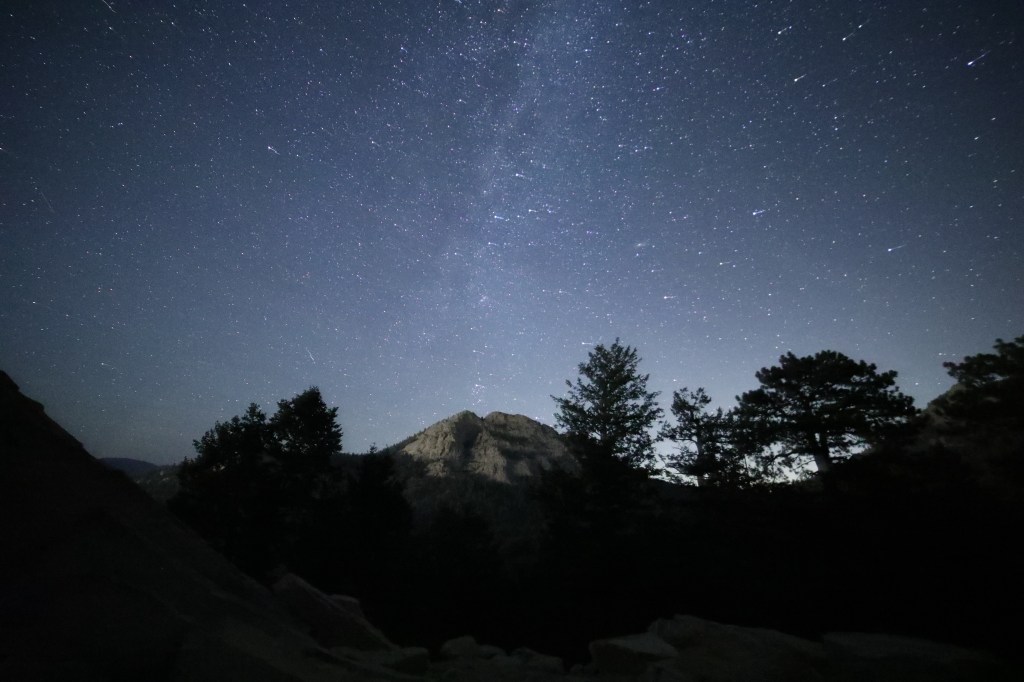
We want aesthetically pleasing astro photos. To get those photos, we need the tripod to be sturdy so that it minimizes any potential shakes or movement of the camera while it is taking said photos.
The brand of tripod I bought was pretty cheap but it has served me well. I bought a Dolica tripod at a Best Buy about 10 years ago and it is what I am still using to this day. I don’t remember how much I paid for it, but I am sure it was less than $40.
Since that time, I also bought a Manfrotto tripod which I have not tested out yet as I need to buy an additional accessory to make it usable with my camera.
The Lens
In photography, different lenses will accomplish different goals for the person taking the picture. With astrophotography, that rule holds true as well.
I love landscape astrophotography, i.e. taking pictures of the night sky and/or celestial bodies, but also including the landscape–whether that be trees, forests, mountains, hills, etc. in the photo as well.
The focal length of your lengths will dictate the angle of view, how much of the scene is captured in your photo. With a short focal length, you will capture a much larger angle of view, i.e. a bigger portion of the scene. With a large focal length, the camera will capture a small angle of view, i.e. a smaller portion of the scene.
In landscape astrophotography, we want to capture as much landscape and sky as possible, so as you suspected, we want a lens with a short focal length.
Personally, I use the Rokinon 14mm f/2.8 lens which has captured some absolutely great shots on my astrophotography adventures.

While I have tried finding additional lenses to see if I can capture even more scenes in my photos, I have not looked too hard because I have been very pleased with this lens.
Camera Settings
You have your camera, your tripod, and you lens and now you are ready to try to take your first shot. You are probably asking yourself what settings to try out.
Well, that is really going to depend on where you are, what you are shooting, the amount of light pollution that is out, and what kind of effect you are trying to achieve with your photos.
I know that sounds like a non-answer and is totally not helpful, but it is the truth. However, the setup I start with in order to get sense of what I need to do with my settings is listed below:
Camera: Manual Mode
Photo Quality: Set to RAW quality to get the most details in the photos
ISO: 1600
White Balance: 3200
Exposure: 20 seconds
Auto Focus: Turned off and set to Manual Focus
I will start with these settings, take a couple pictures, and tweak as necessary. I also carry a small notebook and write down the settings I used so that I can refer to them in the future. If something works for you, write it down, so that you can use those same settings the next time you go out! It saves you time and the frustration of trying to remember how you got a picture a certain way.
That is it with the basics! I mean there is more to it, but that is pretty much what I learned first before actually testing my camera out.
 Etienne Rising's Astrophotography Blog