I can say that I have done astrophotography for about 2 years now. In that time, there has been a great amount of trial-and-error. I came into this hobby knowing nothing. While I have gained some knowledge, I can readily admit that there is still a lot I do not know about.
So many things can go wrong or can cut an astrophotography session short. Sometimes, a night out results in great pictures. However, sometimes things just don’t work out and in those instances, I have gone home empty-handed.
It is through these experiences that I learned a couple things to try to make the most out of my astrophotography sessions and increase the likelihood that I leave with pictures I treasure.
Astrophotography Accessory: Light Source
As much as I love astrophotography, I am one of those people who is very much afraid of the dark. It might sound ridiculous, but it is true.
When I see a horror film, I am one of those individuals whose imagination starts to play tricks on them. I start to see scary figures in the dark and things that aren’t there lol.
When you do astrophotography, you are generally going to want to drive to places out in the country to avoid light pollution in order to get best pictures possible (i.e. capture as many celestial objects in your photos as possible).
That means going to rural places that are very dark at night.
Oftentimes, I find myself to be the only person at these locations where I go and take pictures. Sometimes, I will see fellow astrophotographers—but that has been more of an uncommon thing in my experience. However, when I do see one out, I always try to be friendly and say hello!
Nevertheless, given how dark it is, you are going to want to have a light source with you when do your astrophotography.
It might sound a little contradictory—you have driven away from civilization to get away from light pollution and now I am telling you to bring a light source with you. That is exactly what I am saying here.
Some people do different things regarding light sources: they might bring a key chain, a flash light, or a headlamp with them. I have seen people even use their cellphones as a light source! I don’t recommend that though….
I tend to go with headlamps. I like wearing them on my forehead and it allows my hands to be free so I can focus on my camera settings.
I think astrophotography pictures can be a little deceiving. Many people will take photos and have a lit up foreground–but that is not what it looks like when you are actually out there taking the picture. Those pictures with the lit up foreground are generally the result of some creative photoshopping, i.e. taking a picture of the foreground when it is lit up and blending it with a picture of the night sky or the photographer lighting up the foreground with a light source while the exposure is happening.
While that makes for a dramatic and eye-catching picture, it is not indicative of what you actually encounter outside.
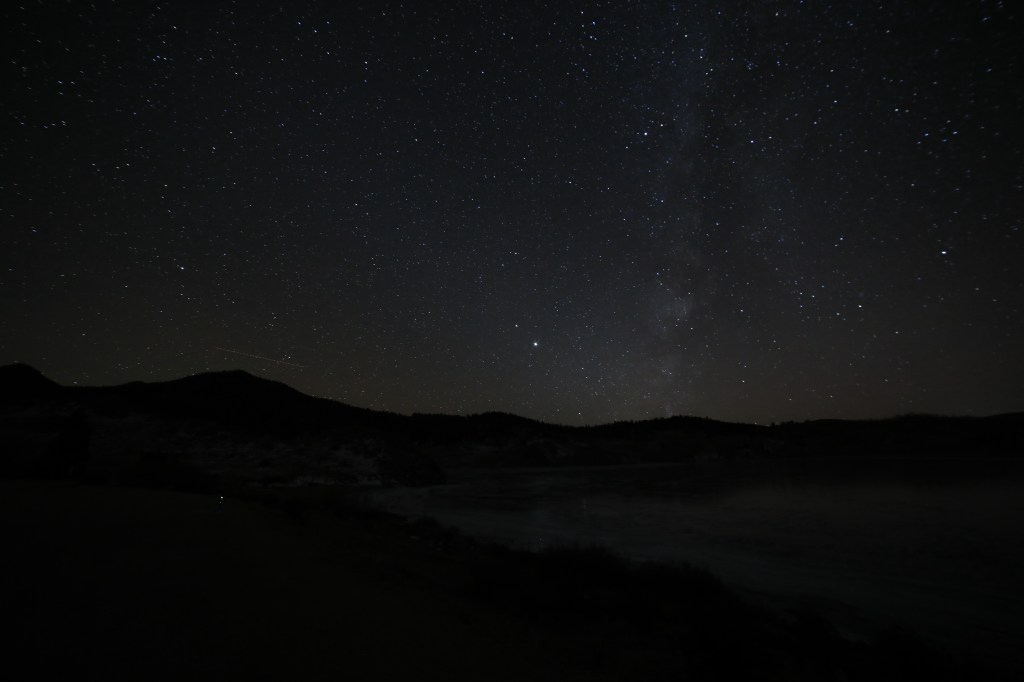
In actuality, it is pitch black when you do astrophotography (you generally want to do it when there is little moonlight, no moon, or a new moon). It’s the kind of darkness where when you hear something crunching leaves or twigs in the dark, you are wondering what the heck that thing is.
Frankly, you can’t see much and you need to see where you are going and that is where the headlamp comes in.
When I started astrophotography, I got a headlamp that had four different settings (3 with increasing lumens and one setting that simply flashed the light of the headlamp). The brand of the headlamp was Petzl. I purchased it at REI for about $20.
It is a pretty great headlamp and I take it with me whether I do hiking or astrophotography.
However, after purchasing my Petzl headlamp, I also realized that when using it, it does mess with your eyes—the bright light disrupts your ability to make out the faint stars when you are doing astrophotography.
I later learned that it is much better to get a light source with a red lamp. I ended up purchasing a red headlamp as that would be less harsh on my eyes, yet still allow me to see my surroundings and my camera as well.
I ended up purchasing two Black Diamond headlamps that not only showed white light, but red light as well. As such, depending on what I was doing, I could change the color of the light, i.e. when I was working with my camera, I’d use the red light to minimize the effect on my eyes. When I was packing up my stuff to leave or heading back to the trailhead, I’d use the white light to see my surroundings. I purchased these headlamps at REI as well.

If you are not into purchasing additional equipment, I have heard of folks making some DIY solutions for this. If you already have a flashlight or headlamp, I have heard of folks using red cellophane material to cover the light source as a cheaper alternative.
Whatever you decide to do, make sure you have a light source. It’s practical, safe, and will save you loads of frustration when you are in the middle of nowhere taking your pictures.
Happy Star Hunting!
Disclaimer: While I have mentioned specific brands that I use in doing astrophotography, I have not been paid anything to promote these products. These are simply items that I have used and liked while doing astrophotography.
 Etienne Rising's Astrophotography Blog