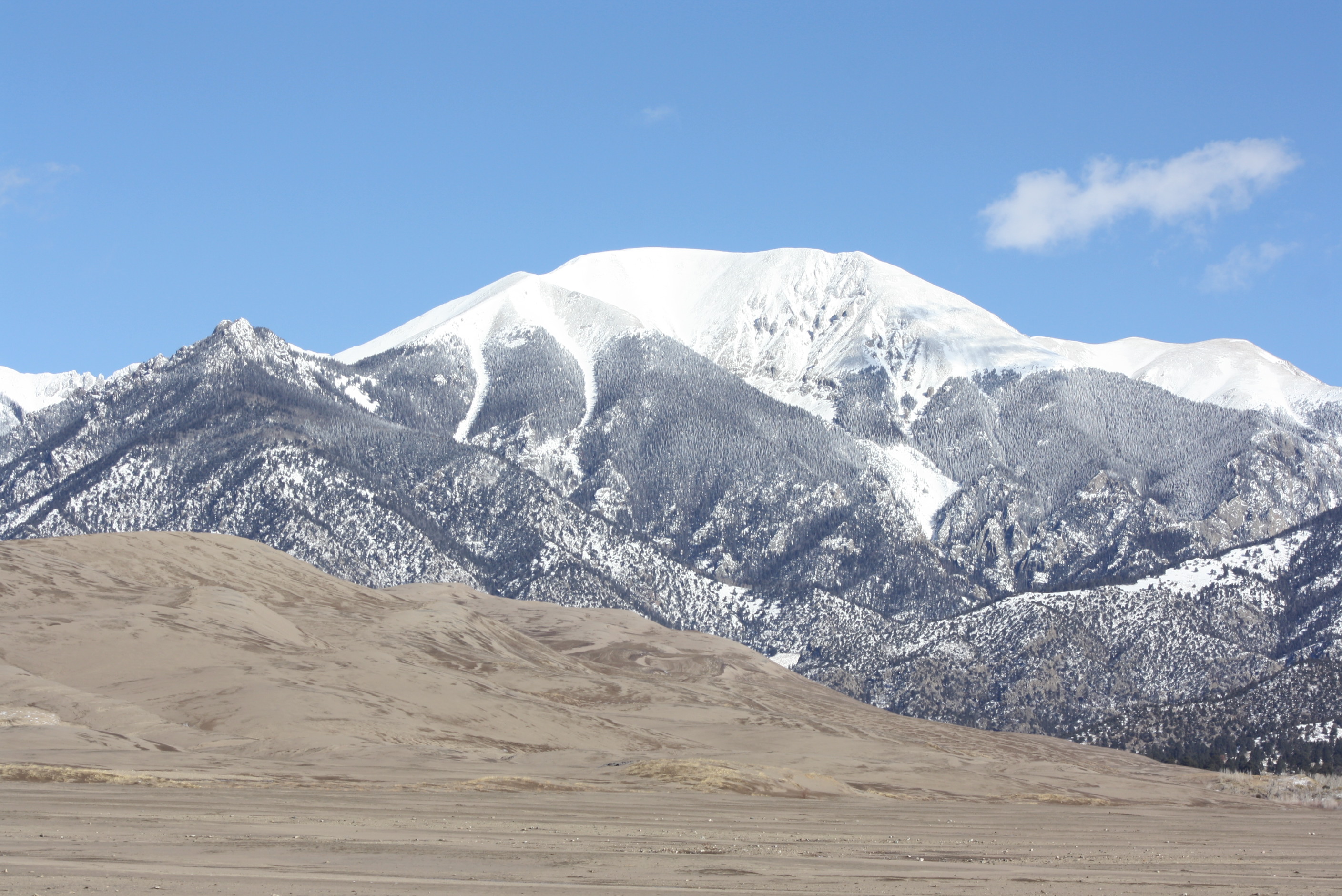
Over the holiday period, I decided to travel to Great Sand Dunes National Park and Preserve. You see, this particular national park is on my bucket list, specifically, it has always been a bucket list goal of mine to take a picture of the Milky Way with the dunes in the foreground.
Great Sand Dunes National Park and Preserve is located about 3.5 hours southwest of Denver in rural Alamosa County, Colorado. The park itself is about a 40-minute drive away from the city of Alamosa–making it a great day trip or night trip, or maybe a bit of both.
I stayed there over the July 4th weekend with the hope that I’d be able that desired shot of the Milky Way glowing over the dunes.
Alas, I have to be honest and say that that unfortunately I wasn’t able to get that desired shot (astrophotography teaches you to roll with the punches). However, I still think I got a pretty nice shot all the same within the confines of the park.

Sometimes, you have to work with what you have.
While I went there with the hope of braving the dunes at night to get my desired shot, I don’t think I made it 10 feet from my car before the mosquitos were trying to bite me up. I don’t know how, but somehow, I forgot about the mosquitos in June and July and how truly annoying they could be.
Given the bugs, I decided to find a different location to try to see if I could get my shot.
While driving around at night, I parked my vehicle and just decided to use the road into the park as my foreground as I figured it would be a pretty striking visual.
I wasn’t disappointed.
Initially it was stormy, but the weather forecast rang true and it cleared up at about 3am. I waited a bit for the Milky Way to be centered with the road and took the above shot. It’s not a stacked shot, but a single exposure, but I am still proud of it all the same.
I think anyone interested in astrophotography should definitely put this park on their travel list. I have looked all over trying to figure out where these skies fall on the Bortle scale (a scale measuring the brightness of a sky–10 being the worst (lots of light pollution) while 1 is the best (being little to no light pollution), and while I have not seen anything definitive, I have read on some sources online that the park is classified in the Bortle 2 area.
Picture Stats:
P1
Date Taken: July 4, 2021
Canon 5D Mark IV
Rokinon 14mm f/2.8
ISO 3200
Exp. 30s
White Balance 3200
 Etienne Rising's Astrophotography Blog