I got into astrophotography in earnest right as the COVID-19 pandemic was about to hit parts of the United States.
When the pandemic happened, I was living in Colorado. I still live in Colorado. I moved there for work, i.e. I left grad school, needed a job, and Colorado provided said job. The fact that it is a beautiful place to live in was simply an added benefit.
Now, pre-pandemic, I was averaging about 50-60 hours of work during the week. It was a grueling schedule.
Also, around this time, a lot had been going on nationwide in the United States. It was a lot of civil unrest. To be honest, using the past tense feels too premature here, because for me personally, I still feel that general civil unrest.
There was an increasing politicization of basic things that used to seem common-sense.
Increasing divides across race, ethnicity, etc.
It takes a toll. I needed time to think. Time to reflect. Time to engage with something other than work and whatever was going on in the country.
I am not even sure what exactly motivated me, but one day I looked up several videos on Youtube regarding getting basic settings for astrophotography. I just wanted to get away from my apartment and do something to take my mind off my existence at that point.
The basic settings that I planned on using:
- Manual Mode for Camera
- Put Lens from Automatic Mode to Manual Mode
- ISO set at about 1600
- Set Exposure for 15-20 seconds.
- I think at this point adjusting my white balance was too advanced for me, so I am pretty sure I never messed with that setting.
It was the dead of winter and I decided to give astrophotography a try (like a real try this time beyond mom’s backyard), since I was actually driving to a location to avoid the light pollution.
I packed up my 1000D, my tripod, several jackets and layers as I wasn’t sure what the weather would be like in the location I headed to. I loaded up my car and took off.
There weren’t a lot of people on the road–unsurprisingly. I ended up picking a mountain location since I correctly deduced not many people would go there given the weather and lack of ski amenities.
I arrived at the spot. It was freezing, cold, and snow covered the roadway–really the entire area.
But…it was dark and there were no other cars around.
I set up the camera on the tripod, input the previous settings.
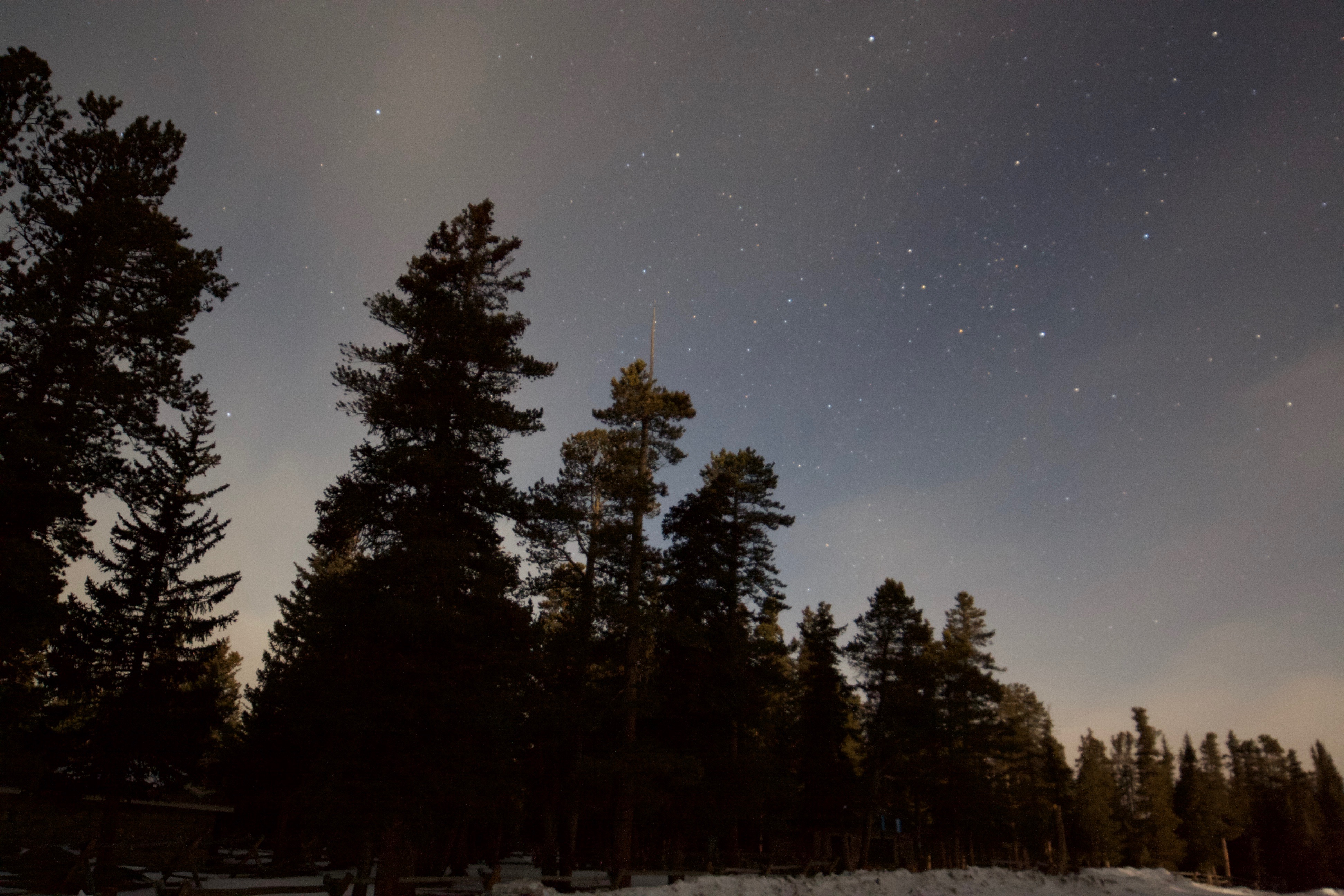
I actually got a semi-decent astrophotography picture.

Honestly, I am still proud of this picture. I recognize that it’s not the best astrophotography picture. However, for me, it represents the culmination of something I have wanted to achieve for a really long time. I went from being an observer of astrophotography to being an active participant in it.

You can see some of the noise showing up as a weird pillar in the background. 
Clouds are rolling in. 
Clouds rolled in completely and it started to snow, albeit lightly.
I stayed up there for as long as I could withstand the cold, which was probably about 1-1.5 hours. I went home and I was absolutely giddy. I couldn’t wait to get home.
While I was generally happy with my pictures, I realized these weird little scribbles and lines would show up in pictures. These were things that were not actually in the background of what was being photographed. You can see an example of that in the first picture in the trio above.
I later learned that that was “noise”–distortions that can show up in photos.
It got me to thinking about whether my camera was a bit dated for astrophotography and whether I needed to upgrade my gear.
Again, a post for another day.
 Etienne Rising's Astrophotography Blog